Friday, January 15, 2010

Infosys becomes first pvt firm to get CISF cover


CISF personnel stand guard at the Infosys building in Electronic City in Bangalore on July 31, 2009. Photo courtesy: AFP

Infosys becomes first pvt firm to get CISF cover

Fri-Jul 31, 2009
Bangalore / Press Trust of India
Software giant Infosys on Friday came under the security blanket of Central Industrial Security Force (CISF), becoming the first private firm to be protected by the force which usually guard government installations.

The commencement of the CISF deployment at the Infosys campus was marked with the hoisting of the CISF flag by company chairman and chief mentor NR Narayana Murthy followed by a ceremonial guard of honour by the force and the official handing over of the security keys by the Infosys.

The Bangalore-headquartered Infosys, which was reported to be on terror radar, had approached the Union Home Ministry earlier this year for a protective cover over and above the capabilities of their own private security wings and agencies.

This is the CISF's first assignment after the force was mandated to protect the private sector with an amendment in the CISF Act in January this year following the Mumbai terror attack.

"This is the first time, since its creation in 1969, that the CISF will be providing security cover to a corporate organisation in India," CISF Inspector General R K Mishra said.

Saturday, January 2, 2010

India on an adventurous and dangerous path: Pakistan Army Chief

January 2, 2010

Paush Krushna Dwitiya, Kaliyug Varsha 5111

Responding to Indian Army Chief General Deepak Kapoor's statement that the Indian Armed forces were ready to fight Pakistan and China simultaneously, Pakistan Chief of Army Staff General Ashfaq Pervz Kayani said the situation in the region could get out of control due to such "dangerous adventurism".
http://www.pakpoint.com/wp-content/uploads/2009/09/Ashfaq-Kayani71.jpg

"The proponents of conventional application of military force, in a nuclear overhang are chartering an adventurous and dangerous path, the consequences of which could be both unintended and uncontrollable," Kayani said while addressing the military's top brass at the General Headquarters.

The Inter Services Public Relations quoted Kayani as saying the Pakistan Army was fully alert and alive to the 'full spectrum of threat, which continued to exist in conventional and unconventional domains.'

He said the Pakistani army duly supports and is contributing to bring peace and stability in the region, but added that necessary action would be taken to thwart any challenge facing the country.

"But at the same time, it (the military) will continue to maintain the necessary wherewithal to deter and, if required, defeat any aggressive design, in any form or shape such as a firmed up proactive strategy or a cold start doctrine," The Daily Times quoted Kayani, as saying.

"An army supported by 170 million people, with faith in Allah, is a formidable force to reckon with," he added.

Source: Rediff

Thursday, December 24, 2009

Indian MoD Allows Blacklisted Firms To participate In Trials

After months of deadlock that stalled the Army’s modernisation plans, the Ministry of Defence (MoD) has given the go-ahead for blacklisted firms to participate in trials to kickstart procurement of five vital defence systems. Trials have been cleared for 155 mm towed guns, artillery shells and light vehicles and rifles for special forces.

As reported first by The Indian Express, seven firms were blacklisted earlier this year following the arrest of former Ordnance Factory Board (OFB) chairman Sudipta Ghosh. As a result, several procurement were put on hold. The Army Chief subsequently made requests to at least allow trials in cases where the tainted firms were contenders.

While trials have been allowed in specific cases based on advice from the Law Ministry and the Central Vigilance Commission, the MoD has said that no contracts will be awarded until the firms have been cleared by the CBI.

“The Army Chief had made specific requests that trials should be held as they will take time. The Law Ministry and CVC agreed with the suggestion that trial process can continue in multi-vendor cases but no contracts will be signed till the CBI case is cleared,” said a top MoD official.

Sources said the decision was taken last week, and the Army has already issued orders for trials. The first trial will be held in February for the estimated $-2 billion order to procure 400 much-needed 155 mm artillery guns. The two contenders for the contract are Singapore Technologies (which had been blacklisted) and UK-based BAE Systems.

But another crucial tender to procure over 100 light howitzers for deployment in mountainous border regions adjoining China and Pakistan continues to be on hold as the only contender is Singapore Technologies. “The decision (to allow trials) is only for multi-vendor cases,” the official said. “The light howitzer contract is on hold as it is a single-vendor situation.”

The Army will now also go ahead with trials for artillery ammunition and armoured fighting vehicle tank protection systems — in both, another blacklisted firm, Israeli Military Industries (IMI), was a contender.Two other contracts for light-weight assault rifles and light strike vehicles for special forces — for both, Singapore Technologies is a contender — will also go ahead with trials.

Courtesy

Asia Defence

Monday, December 21, 2009

Dose--IAF

IAF Commands

The Indian Air Force has seven commands, of which five are operational and two functional, namely :

  • HQ Central Air Command, Allahabad;
  • HQ Eastern Air Command, Shillong;
  • HQ Western Air Command, New Delhi;
  • HQ Southern Air Command, Trivendrum;
  • HQ South-Western Air Command, Gandhi Nagar;
  • HQ Maintenance Command, Nagpur; and
  • HQ Training Command, Bangalore.

The Indian Air Force is divided into the following broad categories :

- Flying operations;
- Maintenance & Logistics;
- Administration; and
- Training.


MiG-29 : Twin engine, single seater air superiority fighter aircraft of Russian origin capable of attaining max. speed of 2445 km per hour (Mach-2.3%29. It has a combat ceiling of 17 km. It carries a 30 mm cannon alongwith four R-60 close combat and two R-27 R medium range radar guided missiles.


Group Captain NK Prashar, JD AF Adv was the first to fly X-Air microlight on night on 15 Sep 2000 at Air Force Station Hindon. Subsequently, on the same night Sqn Ldr MIK Reddy carried out a skydiving jump from X-Air Microlight.


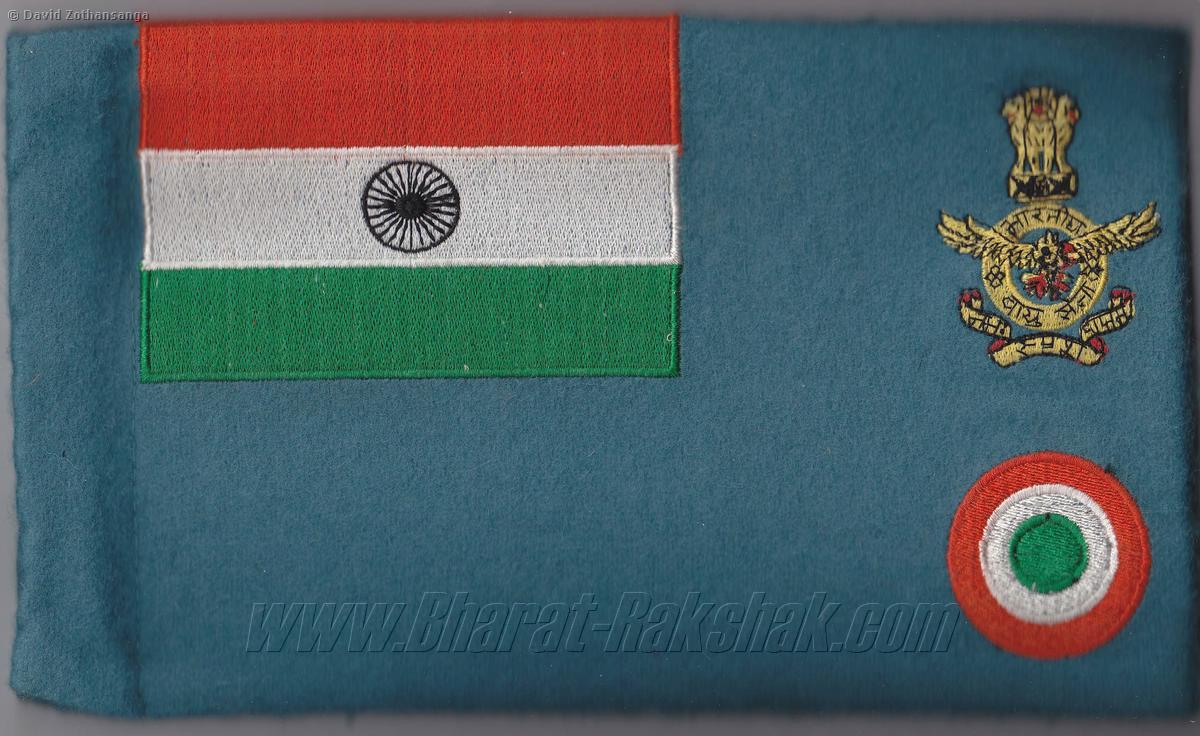
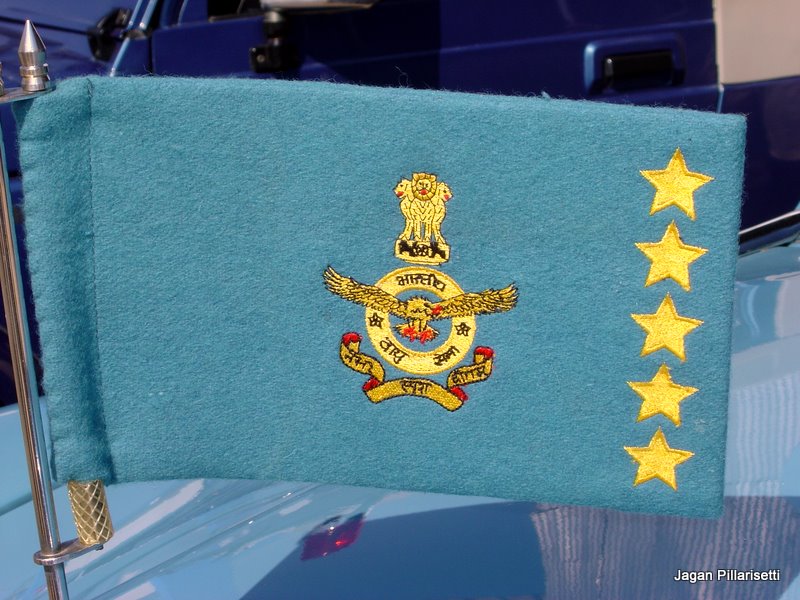
Distinguishing Rank Flags are commonly displayed on masts at various formations as well as on vehicles in which the entitled officer is travelling.

Officers of the rank of Wing Commander and above commanding a formation/ station/ unit (not detachments) are entitled to fly a distinguishing flag, which will measure 2' in the hoist and 3' in the fly. The flag is to be flown at the head of the flag mast of the formation/ station/ unit and is not to be hoisted and lowered daily or flown at half-mast. The flag will be flown at all times except when replaced by the national flag during visits by Government or Foreign dignitaries.

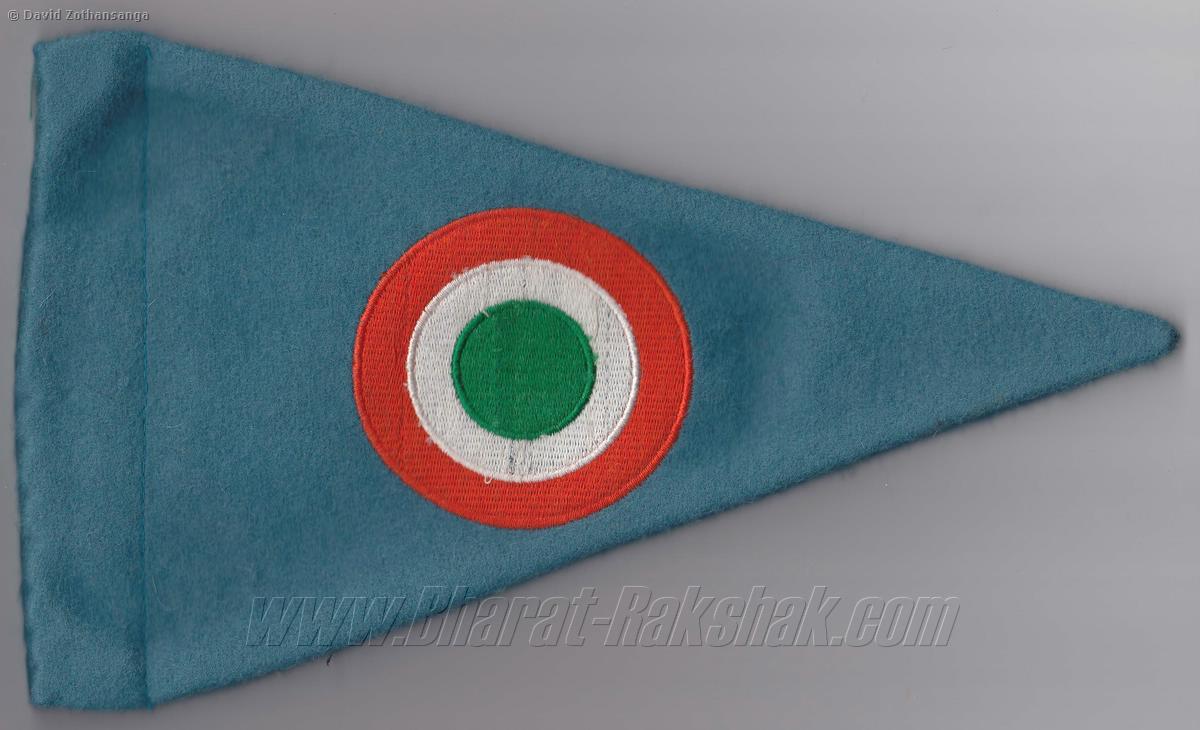
A smaller version of the rank flag is carried on Vehicles.

Marshal of the Air Force

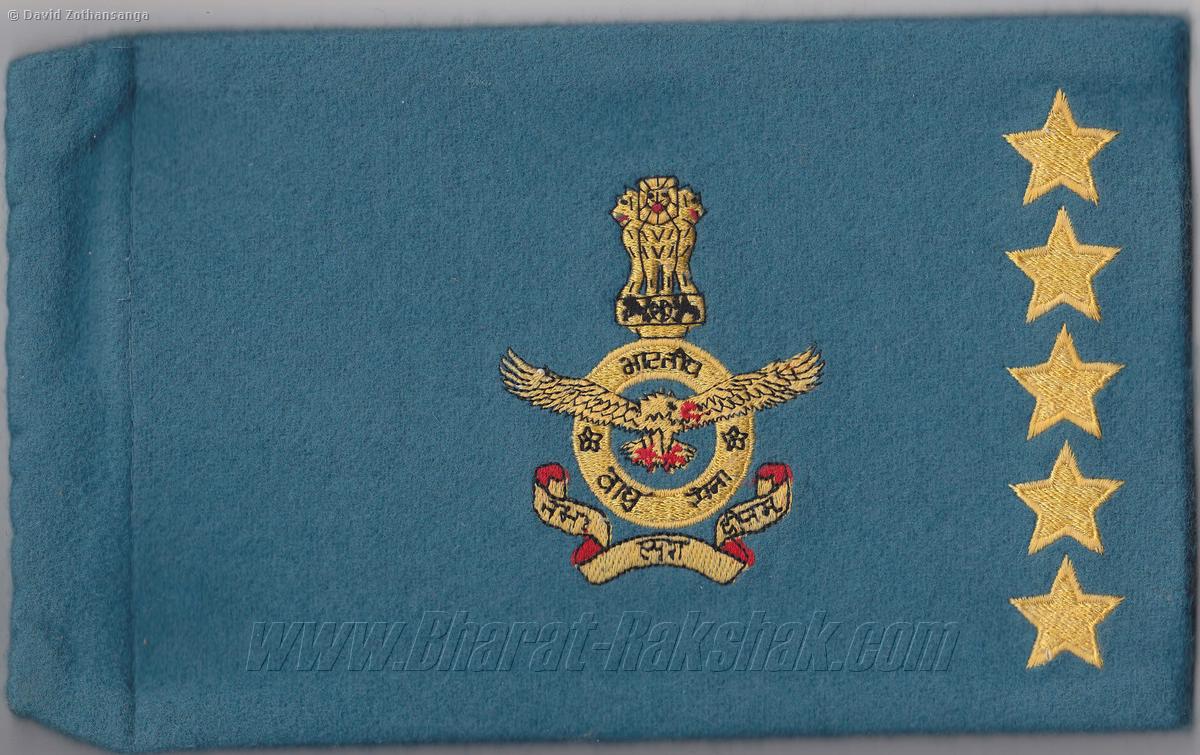
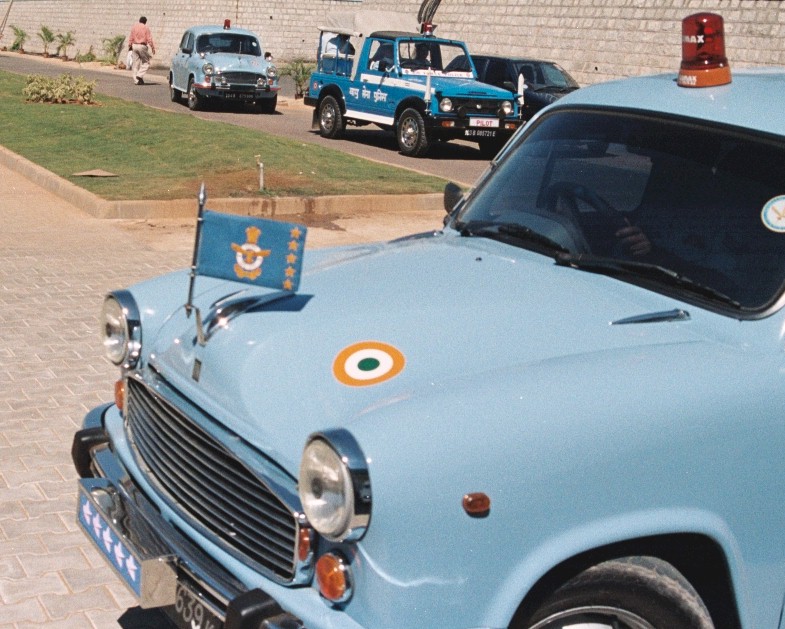
altRank Flag of the Marshal of the Air Force - displaying five star status. Till date , only one person has been entitled to it - Marshal of the Air Force Arjan Singh. See the photograph at the end showing the display of it on a car.

Chief of Air Staff (Air Chief Marshal)

altChief of Air Staff - Air Chief Marshal Rank

Air Officer Commanding in Chief (Air Marshal)

altAir Marshal Rank Flag

Air Vice Marshal

altAir Vice Marshal Rank

Air Commodore

altAir Commodore

Group Captain

altGroup Captain

Wing Commander

altWing Commander

Method of Display on Vehicles

The Flag is prominently mounted on a small flagstaff that is placed in front of the car in center. The photographs below illustrate the flag displayed on Marshal of the Air Force Arjan Singh's Car.

altalt

Rules of Display
(a) At formation/ station where more than one unit is located only the station commander is entitled to fly the flag.
(b) At Air Headquarters and command headquarters the only distinguishing flag flown to be that of the Chief of the Air Staff or the Air Officer Commanding-in-Chief, respectively. Officers Commanding, headquarters units, are not entitled to fly flags.
(c) The flag is to be flown only when the entitled officer is actually present in the headquarters station.
(d) When the Chief of the Air Staff/ AOC-in-C/ AOC visits a station, the distinguishing rank flag of the station commander will continue to be flown and not the rank flag of the inspecting officer.


Courtesy---

Click here to go to Home PageClick here to go to Home PageClick here to go to Home PageClick here to go to Home PageClick here to go to Home PageClick here to go to Home PageBHARAT RAKSHAK


Peace Keeping OF UN BY InDIAN ArMY

United Nations soldiers, part of United Nation...Image via Wikipedia

http://indianarmy.nic.in/writereaddata/Header/Operations/UN%20Mission/2.gif
Peace Keeping

Time and again, India has risked the lives of its soldiers in peacekeeping efforts of the United Nations, not for any strategic gain, but in the service of an ideal. India's ideal was, and remains, strengthening the world body, and international peace and security. While approaching our participation in different peacekeeping operations, we have based ourselves on the basic principles given below :-

  • All means for the peaceful settlement of disputes should be exhausted before establishing a peacekeeping operation.
  • Peacekeeping operations should strictly adhere to principles of the UN Charter, in particular the principles of full respect for the sovereignty and territorial integrity of States, and non-intervention in their internal affairs.
  • Peacekeeping operations should be considered only at the request of the member states involved and should be under the command and control of the UN.
  • Resources for peacekeeping activities should not be at the expanse of resources for development activities of the UN.
  • There should be no hesitation in ending those operations, which have been overtaken by events or become inconsistent with their mandates.
  • It is also important to ensure that the distinction between peacekeeping operations and other activities of the UN, including humanitarian assistance, is maintained at all times.
  • The anticipated duration of a peacekeeping mission should be tied to clear objectives and realistic criteria to end the mission and an exit strategy.

Indian troops have taken part in some of the most difficult operations, and have suffered casualties in the service of the UN. Professional excellence of the Indian troops has won universal admiration.

India has taken part in the UN peacekeeping operations in four continents. It most significant contribution has been to peace and stability in Africa and Asia. It has demonstrated its unique capacity of sustaining large troop commitments over prolonged periods. Presently, India is ranked among the largest and most reliable Troop Contributor Nations to the UN. India has also offered one brigade of troops to the UN Stand- by Arrangements.

Countries, which participate in UN Peacekeeping Operations, have to provide not only the military expertise but also have to be politically acceptable. The range of sensitive peacekeeping operations India has participated in is testimony to India’s image in the world.

India has always contributed generously to UN demands for peacekeeping. Known for their equanimity and forbearance, Indian troops have proved popular everywhere.

The first call came early enough, when India sent troops to Korea to form the Custodian Force (India), which functioned under the Neutral Nations Repatriation Commission headed by Major General (later General) KS Thimayya, DSO in 1953-54. This was a delicate task, involving the repatriation of Prisoners of War. This was followed by a stint at Gaza to keep Israeli and Egyptian forces apart.

The largest (and longest serving) contingent was sent to the Congo in 1961. A complete independent brigade group, it helped bring about peace and thereafter enforce it - which involved light to heavy engagements with motley groups beefed up by white mercenary columns. One most cherished compliment came from an adversary. The mercenaries themselves conceded, in later writings, that the Indian contingent's activity curbed their style. Mention was made of a certain tenacity of purpose in combat.

India has sent battalion groups, engineers, medical teams, mil observers and staff personnel to Cambodia, Sierra Leone, Rwanda, Lebanon, Ethiopia-Eritrea, Congo, Sudan and Golan Heights. Observers and staff personnel have made their contributions to the international peace efforts in Central America, Iran, Yemen, Iraq, Kuwait, Liberia, Lebanon, Mozambique, Congo, Ethiopia-Eritrea, Sudan and Golan Heights. After Korea (1950-52) and Congo (1960-63), India again sent a brigade group to Somalia and Congo displaying its resolve to support international community in peace and security issues.

India has also provided able leaders for various missions in General Thimayya in Korea & Cyprus, Lt Gen Dewan Prem Chand in Cyprus & Namibia, Lt Gen Satish Nambiar in Yugoslavia, Maj Gen Inderjit Rikhye in Sinai, West Irian & Yemen, Maj Gen PS Gyani in Yemen, Sinai & Cyprus, Maj Gen V Jaitley in Sierra Leone Maj Gen LM Tiwari in Lebanon, Maj Gen(now Lt Gen) Rajender Singh, SM, VSM in Ethiopia-Eritrea, Lt Gen RK Mehta,PVSM, AVSM, YSM, VSM as Military Adviser to the Secretary General in UN HQ, Lt Gen JS Lidder, UYSM, AVSM in Sudan and Maj Gen Bikram Singh, AVSM, SM, VSM as Divisional Commander in Congo apart from many a contingent commanders.


cOURTESY ---
ARMY WEBSITE

Friday, December 18, 2009

The Indian Army

The Indian Army is the world's second largest army in terms of military personnel. The basic responsibility of the Army is to safeguard the territorial integrity of the nation against external aggression. In addition, the Army is often required to assist the civil administration during internal security disturbances and in the maintenance of law and order, in organising relief operations during natural calamities like floods, earthquakes and cyclones and in the maintenance of essential services.

Indian Army is one of the finest armies in the world. Modernisation and upgradation of Army is a continuous process to keep the Armed Forces ready to meet any challenge of tomorrow. It is based on five year plans. Focus and core areas of modernisation have been:-

* Improvement in the Fire Power and increased Mobility
* All Weather Battle Field Surveillance capability
* Night Fighting capabilities
* Enhance capability of Special Forces
* Capability for Network Centric Warfare
* NBC Protection

The main focus for the Artillery is to acquire heavy calibre Guns with enhance ranges with better fire power mobility. Acquisition of additional Unmanned Aerial Vehicles (UAVs) and Night Vision Surveillance Devices by Artillery will enhance the Surveillance and Target Acquisition capability.

The combat potential of Infantry and Rashtriya Rifles is being comprehensively transformed through a quantum enhancement of surveillance, firepower, protection, communication and mobility requirements. In pursuit of modernisation, the Infantry Battalions are being provided state-of-the-art weapon systems of greater lethality, range and precision, thermal imaging devices, bullet and mine proof vehicles and secure radio communications.
Recruitment in Indian Army

Apart from the UPSC entries, the commissioned officers are recruited in the army through the following Non-UPSC entries:-

* University Entry Scheme (UES) : Final/pre-final year students in the notified engineering disciplines are eligible to apply for Permanent Commission in the Technical Arms of the Army as Commissioned Officers under the UES. Eligible candidates are selected through a campus interview by the Screening Teams deputed by the Army Headquarters. These candidates are required to appear before SSB and Medical Board.
* Technical Graduates Course (TGC) : Engineering graduates/post graduates from notified disciplines of engineering are eligible to apply for Permanent Commission through this entry. After the SSB and the Medical Board, the selected candidates are required to undergo one year pre-commission training at the IMA, Dehradun.
* Short Service Commission (Technical Entry) : The Short Service Commission (Technical) Entry Scheme provides avenue for recruitment to eligible technical graduates/post graduates into Technical Arms. After SSB and Medical Board, the selected candidates are required to undergo approximately 11 months pre-commission training at OTA, Chennai.
* 10+2 Technical Entry Scheme (TES) : Candidates who have qualified 10+2 CBSE/ICSE/State Board Examination with minimum aggregate of 70% marks in Physics, Chemistry and Mathematics are eligible to apply for commission under the 10+2 TES.
* Women's Special Entry Scheme Officers (WSES-O) : Eligible women candidates are recruited in the Army as Short Service Commissioned Officers through the (WSESO). Commission is granted in Corps of Electronics and Mechanical Engineers, Signals, Army Education Corps, Army Ordinance Corps, Army Supply Corps, Military Intelligence Corps, Judge Advocate General's Branch and Army Air Defence.
* NCC (Special) Entry Scheme : University graduates possessing NCC 'C' Certificate with minimum 'B' grade and 50% marks in graduation examination are eligible to apply for Short Service Commission through this entry. Such cadets are exempted from written examination conducted by the UPSC and are directly put through the SSB interview followed by a medical board.
* Recruitment of Personnel below Officer Rank (PBOR) : Recruitment of PBOR in the Army is carried out through open rallies. After the preliminary screening of aspiring candidates at rally site followed by document checking and physical fitness test their medical examination is conducted by Recruiting Medical Officers at the rally site.

This is followed by a written examination for the medically fit candidates. Successful candidates are sent to respective training centres for training. There are eleven Zonal Recruiting Offices, two Gorkha Recruiting Depots and one Independent Recruiting Office in addition to 47 Regimental Centres which carry out recruitment through rallies in their respective areas of jurisdiction.

Source: National Portal Content Management Team, Reviewed on: 31-03-2009

Thursday, December 17, 2009

Indian Refueler Program May Be Rebid

NEW DELHI - India's purchase program for six midair refuelers may be rebid after questions arose regarding bid cost and competitiveness, Indian Defence Ministry sources said.

"The procurement proposal had been progressed in accordance with the Defence Procurement Procedure-2006 and thereafter referred to the Ministry of Finance, who has expressed certain reservations relating to the competitiveness of the bids and the reasonableness of the price," says a Dec. 14 Defence Ministry release, quoting the official reply of Defence Minister A. K. Antony to India's Parliament.

Four years ago, a request for proposal was sent to U.S.-based Lockheed Martin and Boeing, EADS and Ilyushin of Tashkent.

Lockheed Martin and Boeing did not respond to the tender, leaving only Ilyushin and EADS in the fray.

Ilyushin's bid was lower than that of EADS but the Air Force favored buying the A330 multirole tanker over the IL-78 of Ilyushin, which it had been using. The matter was referred to the Finance Ministry, which rejected the Air Force request, saying the lowest bidder should be the obvious choice.

http://www.bharat-rakshak.com/NEWS/newsrf.php?newsid=12084